

For decades, the global conversation surrounding air pollution has been dominated by its immediate and highly visible impacts on human biology: chronic respiratory decline, asthma exacerbation, and cardiovascular disease. As urbanization accelerates, industrial landscapes evolve, and global populations migrate into hyper-dense megacities, the prevailing narrative has framed atmospheric contamination primarily as a threat to our lungs and our hearts.
However, modern medical research and advanced epidemiological studies have initiated a profound paradigm shift. The scientific community has reached a chilling consensus: the air we breathe is fundamentally altering our metabolic health. Air pollution is no longer viewed solely as a respiratory irritant; it is now universally recognized as a severe, environmental endocrine disruptor directly linked to the onset, progression, and exacerbation of Type 2 Diabetes Mellitus (T2DM).
Understanding this invisible metabolic crisis—and engineering architectural solutions to combat it—is no longer a theoretical medical pursuit. It is a vital necessity for modern living. This comprehensive guide explores the deep biological mechanisms linking airborne contaminants to metabolic dysfunction, analyzes the latest peer-reviewed global data, and outlines the advanced indoor air quality (IAQ) and molecular filtration technologies required to reclaim our environmental safety.
The Traditional Paradigm vs. The New Biological Reality
Type 2 Diabetes has historically been classified as a lifestyle and genetic disease, driven primarily by factors such as sedentary behavior, hyper-caloric diets, adiposity (body fat), and hereditary predisposition. While these factors remain undeniable pillars of metabolic health, they fail to entirely explain the exponential, runaway growth of diabetes diagnoses in rapidly developing, highly polluted urban centers.
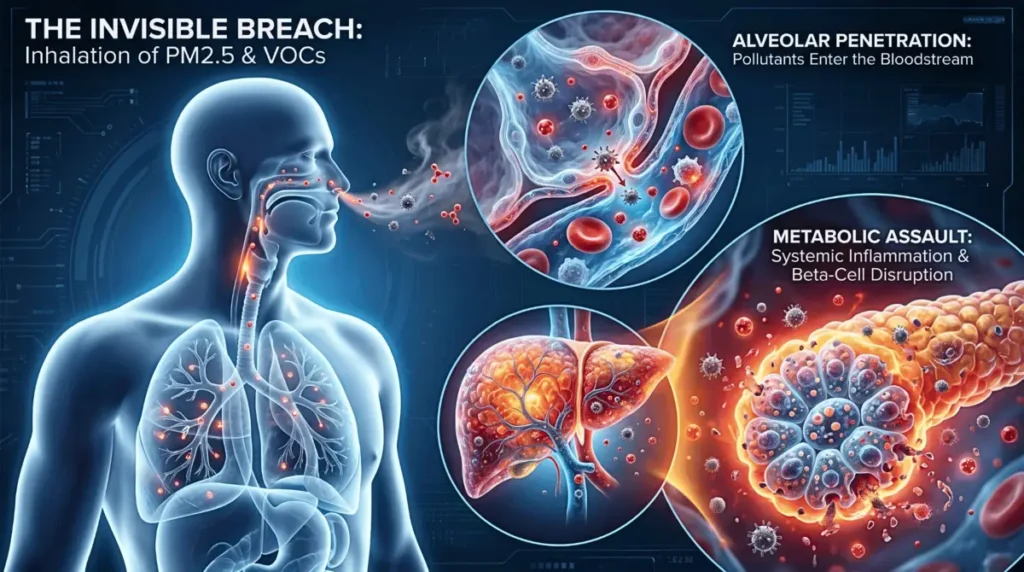
The missing variable in the global diabetes equation is our environment. Researchers have discovered that microscopic particulate matter (PM2.5) and gaseous pollutants act directly upon the body’s cellular machinery. They do not simply irritate the surface of the lungs; they breach the body’s natural defenses, enter the bloodstream, and actively impair the organs responsible for glucose regulation.
The Statistical Mandate: Global Burden of Disease
To comprehend the sheer scale of this crisis, we must examine the data. A landmark study published in The Lancet Planetary Health, which tracked and analyzed 1.7 million subjects over an 8.5-year longitudinal period, completely redefined the risk models associated with ambient air quality.
The research revealed that outdoor air pollution contributed to an estimated 3.2 million new Type 2 Diabetes cases globally in a single year. This staggering epidemiological impact represents roughly 14% of all new diabetes cases worldwide. Crucially, the researchers noted that the risk of developing diabetes significantly increases even at lower pollution levels that were previously considered “safe” by global health organizations and environmental protection agencies.
This statistical mandate proves that lifestyle interventions alone are insufficient to combat the diabetes epidemic. True metabolic protection requires environmental control.
The Anatomy of Inhalation: How PM2.5 Triggers Metabolic Dysfunction
To understand how a pollutant suspended in the air can fundamentally alter how the human body processes glucose, we must trace the biological journey of fine particulate matter, specifically PM2.5.
PM2.5 refers to particulate matter that is 2.5 micrometers or less in diameter—roughly 1/30th the width of a single human hair. Because of its microscopic scale, PM2.5 behaves fundamentally differently than larger atmospheric dust (PM10).
Penetrating the Alveolar Barrier
When humans inhale large dust particles or pollen, the body’s primary respiratory defenses—mucus membranes and cilia in the nose and throat—trap and expel the invaders. PM2.5, however, easily bypasses these upper respiratory filters. It travels deep into the terminal bronchioles and reaches the alveolar region of the lungs, where oxygen and carbon dioxide are exchanged.
Because PM2.5 particles are so incredibly small, they cross the alveolar-capillary membrane and enter directly into the systemic bloodstream. Once in the circulatory system, these toxic particles are transported to every major organ in the body, including the liver, adipose tissue, skeletal muscle, and the pancreas.
Systemic Inflammation and Cytokine Cascades
Once PM2.5 particles infiltrate the body’s tissues, the immune system recognizes them as foreign, toxic bodies. Macrophages, the white blood cells responsible for engulfing cellular debris and foreign substances, attempt to digest these particles. However, because PM2.5 often contains a toxic cocktail of heavy metals, black carbon, and polycyclic aromatic hydrocarbons (PAHs), the macrophages cannot easily break them down.
This failure triggers a state of chronic, low-grade systemic inflammation. The distressed immune system releases a flood of pro-inflammatory cytokines, specifically Interleukin-6 (IL-6) and Tumor Necrosis Factor-alpha (TNF-α). As these inflammatory markers circulate in high volumes throughout the body, they actively interfere with the insulin signaling pathways within our cells.
When a healthy cell receives insulin, it acts as a key to unlock the cell membrane, allowing glucose from the blood to enter and be used for energy. The inflammatory cytokines triggered by PM2.5 physically disrupt this cellular “lock,” causing the cell to become resistant to insulin. Consequently, the pancreas must produce increasingly larger amounts of insulin to force glucose into the cells, eventually leading to metabolic exhaustion.
Endoplasmic Reticulum (ER) Stress and Pancreatic Beta-Cell Apoptosis
Beyond insulin resistance in peripheral tissues, PM2.5 inflicts direct, catastrophic damage on the pancreas itself. The pancreas contains specialized clusters of cells known as the Islets of Langerhans, which house the beta cells responsible for manufacturing, storing, and releasing insulin.
Medical research demonstrates that the oxidative stress induced by fine particulate matter causes severe Endoplasmic Reticulum (ER) stress within these beta cells. The ER is the cellular factory responsible for folding and packaging proteins (like insulin). Under the constant assault of PM2.5-induced reactive oxygen species (ROS), the ER becomes overwhelmed, leading to misfolded proteins and cellular dysfunction. If this environmental stress is sustained long-term, the beta cells undergo apoptosis (programmed cell death). As pancreatic beta-cell mass declines, the body entirely loses its ability to regulate blood glucose, solidifying the onset of irreversible Type 2 Diabetes.
The Gaseous Threat: NO2, Volatile Organic Compounds, and Endocrine Disruption
While particulate matter poses a massive structural threat to our metabolic pathways, true environmental control requires an understanding of gaseous pollutants. Gases exist as individual molecules, making them thousands of times smaller than a PM2.5 particle. These chemical pollutants act as highly aggressive endocrine disruptors.
Benzene and the Microglial NF-κB Pathway
A groundbreaking study recently published in the prestigious journal Diabetes by researchers at Wayne State University and the American Diabetes Association established a robust and frightening association between volatile organic compounds (VOCs)—specifically benzene—and rapid insulin resistance.
Benzene is a pervasive VOC found abundantly in both outdoor industrial emissions and indoor environments (released through the off-gassing of paints, modern synthetic furnishings, adhesives, and cleaning agents). The Wayne State University research team revealed that within merely seven days of continuous exposure to ambient benzene, subjects developed notably high blood glucose and insulin levels.
The study isolated the exact biological mechanism behind this rapid metabolic decline: the microglial NF-κB signaling pathway. Microglia are the primary immune cells of the central nervous system. When inhaled benzene crosses the blood-brain barrier, it activates the NF-κB pathway in the brain, triggering localized neuroinflammation. This neuroinflammation rapidly disrupts the brain’s ability to communicate properly with the body’s metabolic organs, proving that airborne toxicants directly induce chemical-driven metabolic disturbances via a brain-metabolism axis.
Nitrogen Dioxide (NO2) and Youth Vulnerability
Traffic-related air pollution (TRAP) is another primary driver of metabolic dysfunction, with Nitrogen Dioxide (NO2) being one of its most dangerous constituents. Produced primarily by vehicular exhaust and the combustion of fossil fuels, NO2 acts as a potent oxidative agent within the human body.
A vital longitudinal study utilizing National Institutes of Health (NIH) data observed youth cohorts in Los Angeles to determine the long-term metabolic effects of TRAP. The findings were stark: prolonged exposure to NO2 and PM2.5 was associated with a significantly faster decline in insulin sensitivity and pancreatic beta-cell function in youths.
Crucially, the NIH researchers noted that these adverse effects on glucose homeostasis occurred completely independently of the subjects’ adiposity. Even lean youths with no traditional lifestyle risk factors demonstrated rapid metabolic decline when continuously exposed to high levels of NO2. This isolates ambient air pollution as a direct, independent driver of metabolic dysfunction, fundamentally altering how we must approach preventative health in modern urban environments
Examining the Global Cohort Evidence: What the Data Reveals
The biological mechanisms established in laboratories are currently playing out on a massive scale across global populations. Epidemiological cohort studies provide the macro-level data confirming the localized micro-level biology.
The Indian Urban Context (BMJ Data)
Rapidly developing economies face the most severe compounding risks of industrialization, urbanization, and compromised air quality. A major cohort study published in The British Medical Journal (BMJ) focused specifically on the effects of PM2.5 in two highly polluted Indian megacities.
The researchers tracked fasting plasma glucose (FPG) and HbA1c levels (a measure of average blood sugar over three months) across the subjects. The data revealed a direct, undeniable temporal association between pollution exposure and worsened glycemic markers. Specifically, a 10 μg/m³ increase in the annual average PM2.5 exposure was associated with a 1.22 times increased risk of incident Type 2 Diabetes. The higher the ambient concentration of particulate matter, the higher the measurable spikes in FPG and HbA1c, highlighting a severe public health burden uniquely tied to the atmosphere.
Compounding Risks for Pre-existing Diabetics
The dangers of air pollution do not stop at the onset of the disease; they drastically accelerate mortality for those already living with the condition. An 11-year prospective cohort study published in The Lancet eBiomedicine tracked over 174,000 individuals newly diagnosed with T2DM.
The findings confirmed that individuals already living with T2DM are disproportionately vulnerable to the negative health impacts of prolonged PM2.5 and NO2 exposure. Because their cardiovascular and metabolic systems are already compromised by the disease, elevated exposure to these specific pollutants was substantially linked to vastly increased risks for all-cause mortality, including fatal cardiovascular disease, respiratory failure, and specific systemic cancers. For a diabetic patient, breathing compromised air acts as a direct catalyst for severe medical complications.
The Indoor Air Quality (IAQ) Crisis: A Concentrated Danger
While discussions of PM2.5 and nitrogen dioxide often conjure images of industrial smog and heavy highway traffic, a much more immediate and insidious threat exists far closer to home. Modern humans spend upwards of 90% of their lives indoors—inside offices, commercial spaces, and residential homes. Yet, indoor air quality (IAQ) is frequently found to be two to five times more polluted than outdoor environments.
The Illusion of the Sealed Modern Home
Modern architectural design heavily emphasizes airtight insulation, double-glazed windows, and advanced weatherproofing. The goal of these design choices is energy efficiency—keeping artificially heated or cooled air inside to lower carbon footprints and utility costs.
While beneficial for temperature control and thermodynamics, this creates completely sealed, stagnant environments. In these airtight boxes, outdoor pollutants that seep in become permanently trapped. Furthermore, the indoor environment generates its own massive toxic load. Volatile organic compounds (VOCs) constantly off-gas from engineered wood, carpets, upholstery, and harsh chemical cleaning agents. Biological aerosols, pet dander, and cooking fumes compound the issue.
Without precision ventilation and active purification, the modern home and corporate office inadvertently become highly concentrated reservoirs for unseen toxins. When you sleep, work, and relax in these environments, you subject your body to a continuous, concentrated micro-dose of the exact endocrine-disrupting chemicals responsible for driving metabolic dysfunction.
Engineering the Solution: The Limitations of Traditional Particulate Filters
Addressing the modern air quality crisis requires moving beyond passive awareness to active, technology-driven intervention. However, the standard approaches to indoor air purification are fundamentally ill-equipped to handle the specific threats driving the diabetes epidemic.
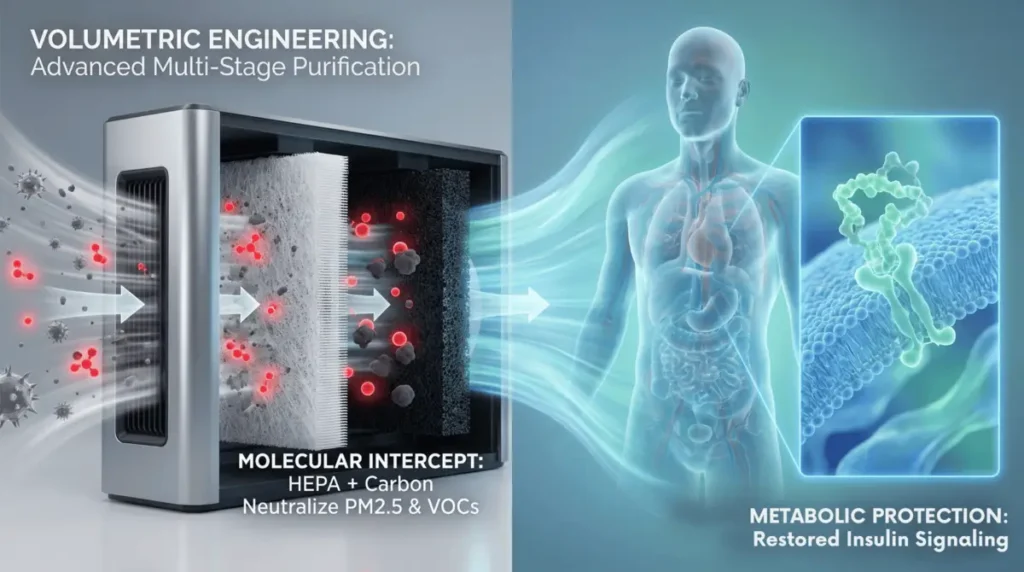
The standard for indoor environments has long been High-Efficiency Particulate Air (HEPA) filtration. Architectural-grade HEPA filters are engineered to physically capture 99.97% of fine particulate matter down to 0.3 microns, including dust, pollen, mold spores, and PM2.5. They accomplish this by forcing air through a dense, physical net of randomly arranged fiberglass fibers.
Why HEPA is Blind to Molecular Contamination
While HEPA is non-negotiable for capturing PM2.5 and halting the physical triggers of systemic inflammation, it is completely useless against the chemical triggers of metabolic disease.
HEPA filters act as physical sieves. Volatile organic compounds (like benzene) and gaseous pollutants (like nitrogen dioxide and formaldehyde) do not exist as physical particles; they exist as singular molecules. These molecules are typically 1,000 to 10,000 times smaller than a PM2.5 particle. If you attempt to catch NO2 or benzene with a HEPA filter, the gas molecules simply slip right through the microscopic holes in the physical net and continue circulating through your breathing zone.
Because the most dangerous endocrine disruptors—the specific compounds proven to trigger the microglial NF-κB pathway and induce rapid insulin resistance—are gaseous, relying solely on particulate filtration leaves an entire dimension of molecular contamination unaddressed.
The Mechanics of Molecular Filtration
To neutralize the chemical threats responsible for driving metabolic disease, a completely different engineering approach is required: molecular filtration.
Molecular filtration operates on the principles of chemistry rather than physical interception. It utilizes the process of adsorption, which traps gaseous molecules onto the internal structures of highly porous, engineered substrates.
Engineered Adsorbents and Massive Surface Area
The most effective and commonly utilized material for molecular filtration is premium activated carbon. Activated carbon is engineered through a high-heat activation process that creates a vast, microscopic network of cracks, crevices, and pores within the carbon structure.
This internal labyrinth gives high-quality activated carbon an expansive internal surface area, often exceeding 1,000 square meters per single gram of material. As contaminated indoor air is forced through a deep-bed molecular filtration system, gas molecules diffuse into the carbon’s microscopic pores. Through a phenomenon known as Van der Waals forces, the gas molecules repeatedly collide with the internal carbon surfaces, lose their kinetic energy, and become permanently bonded to the substrate. This ensures that VOCs like benzene are completely stripped from the airspace before they can be inhaled.
Chemisorption and Targeted Eradication
While broad-spectrum activated carbon handles most standard volatile organic compounds, certain highly reactive, low-molecular-weight gases—such as formaldehyde (HCHO) and hydrogen sulfide (H2S)—require a more aggressive chemical intervention.
Advanced molecular filtration architectures utilize a process called chemisorption. In this process, the adsorbent substrate (often activated alumina) is chemically impregnated with specific reactive agents, such as potassium permanganate. When a targeted gas molecule contacts the impregnated substrate, an instantaneous, irreversible chemical reaction occurs. The toxic gas is physically transformed into a harmless, inert solid salt, permanently neutralizing the threat. By combining high-efficiency HEPA nets with deep-bed, multi-stage molecular filtration, we can successfully eradicate both the particulate and gaseous drivers of Type 2 Diabetes from our indoor environments.
Architectural Implementation: Volumetric Air Engineering
Understanding the filtration physics is only half the battle; deploying it effectively within a living or working space requires precise architectural implementation. A small, consumer-grade air purifier sitting in the corner of a room is woefully inadequate for combating systemic, environment-wide molecular contamination.
To truly protect an indoor environment and reduce the ambient chemical load responsible for endocrine disruption, the purification technology must be integrated at scale. This requires volumetric air engineering.
Centralized, Non-Ducted Purification Ecosystems
Modern luxury spaces and critical corporate environments demand high-capacity, centralized, non-ducted air purification systems. Unlike traditional HVAC add-ons that suffer from pressure drops and rely on notoriously dirty, inaccessible ductwork, independent centralized systems operate within the living space itself to establish total environmental dominance.
By utilizing high-static pressure fans and specialized aerodynamic geometries, these advanced systems generate massive, controlled airflows. This process aggressively pressurizes the environment with pristine, scrubbed air, constantly diluting the indoor concentrations of off-gassing VOCs and neutralizing infiltrating outdoor NO2. The result is a continuous, rapid air-exchange rate that mathematically guarantees the air you breathe is free from the invisible chemical catalysts of metabolic disease.
Conclusion: Reclaiming Environmental and Metabolic Health
The data from the World Health Organization, the National Institutes of Health, and the broader global scientific community is unequivocal. Air pollution is no longer a distant, abstract environmental issue; it is a pervasive, immediate threat actively dismantling human metabolic health. As the microscopic and molecular links between PM2.5, volatile organic compounds, and Type 2 Diabetes become undeniable, the demand for uncompromising, technology-driven indoor air quality will only rise.
Protecting ourselves from this invisible epidemic requires moving beyond outdated filtration concepts. It demands precision engineering, massive surface-area molecular adsorption, and intelligent, high-capacity architectural integration.
Founded by IIT Kharagpur alumni, MeVaChi Solutions operates at the forefront of this exact intersection of health technology and volumetric engineering. By specializing in advanced centralized, non-ducted air purification systems and medical-grade molecular filtration, we provide the architectural defense necessary to combat the modern air quality crisis.
Transforming our living and working spaces into meticulously engineered sanctuaries of clean air is the ultimate investment in our longevity, our metabolic stability, and our overarching well-being. The threat is microscopic, but with the right technology, our control over the air we breathe can be absolute.