
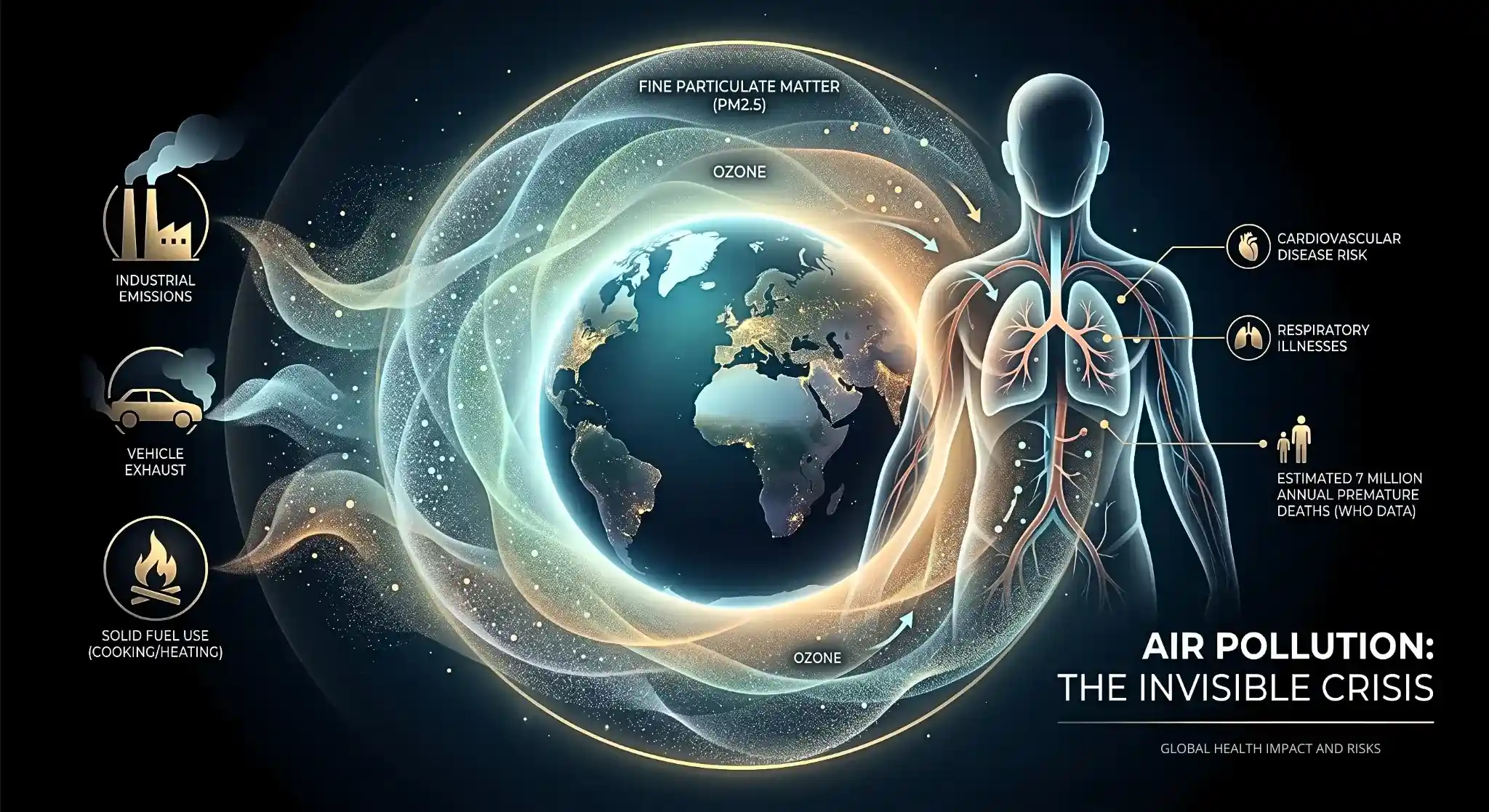
Air is the most fundamental element of human life, yet it is increasingly becoming the most compromised. As urbanization accelerates and global industrial landscapes evolve, the quality of the air we breathe has shifted from an environmental afterthought to a primary determinant of human health.
According to the latest insights from the World Health Organization (WHO) and global health research initiatives into 2026, the effects of air pollution on human health are both profound and systemic. Understanding this invisible crisis—and engineering solutions to combat it—is no longer a luxury, but a vital necessity for modern living.
The Global Reality: WHO Air Quality Guidelines
The statistics surrounding global air quality present a clear mandate for change. Extensive research, including data aligned with the Global Burden of Disease study, attributes over 7 million deaths annually to air pollution exposure. This translates to roughly 1 in 8 global deaths linked directly to the air we breathe.
In response to these compounding health risks, the WHO has established rigorous Global Air Quality Guidelines. These standards underscore a critical truth: there is no “safe” level of pollution. The guidelines specifically target PM2.5—fine particulate matter measuring 2.5 micrometers or less in diameter. The WHO recommends that annual average concentrations of PM2.5 should not exceed 5 µg/m³. Yet, in densely populated and rapidly developing regions, from Central Asia to global megacities, average daily exposures frequently shatter these thresholds.
The Anatomy of PM2.5 and Human Health
Why is PM2.5 so dangerous? Its threat lies in its microscopic scale. These particles are small enough to bypass the human body’s natural respiratory defenses, penetrating deep into the alveolar region of the lungs and crossing directly into the bloodstream.
Long-term exposure is not merely an irritant; it is a catalyst for severe chronic conditions. Research continually links sustained PM2.5 exposure to:
Cardiovascular disease: Increased risk of ischemic heart disease and stroke.
Respiratory decline: The exacerbation of asthma and the acceleration of chronic obstructive pulmonary disease (COPD).
The Hidden Threat: Indoor Air Quality (IAQ)
While industrial smog and vehicular exhaust dominate the conversation, a more immediate threat exists closer to home. Modern humans spend up to 90% of their time indoors, yet indoor air quality (IAQ) is often significantly more polluted than outdoor environments.
Modern architectural design emphasizes airtight insulation for energy efficiency. While beneficial for temperature control, this creates sealed environments where outdoor pollutants, volatile organic compounds (VOCs) from furnishings, and biological aerosols become trapped and concentrated. Without precision ventilation and active purification, the modern home and office can inadvertently become a reservoir for unseen toxins.
Engineering a Sanctuary: Advanced Clean Air Solutions
Addressing the modern air quality crisis requires moving beyond passive awareness to active, technology-driven intervention. The standard for premium indoor environments now necessitates integrated, intelligent air purification systems that operate seamlessly and silently in the background.
The most effective, research-backed technologies dominating the high-end air purifier market include:
Architectural-Grade HEPA Filtration: High-Efficiency Particulate Air (HEPA) filters remain the gold standard, engineered to physically capture 99.97% of fine particulate matter, including dust, pollen, and smoke.
Activated Carbon Integration: Essential for neutralizing VOCs, chemical pollutants, and odors that physical filters cannot catch.
Smart, Real-Time Monitoring: The future of IAQ relies on intelligent, IoT-connected sensors that constantly analyze room data, automatically adjusting performance to maintain pristine air quality without user intervention.
Reclaiming the Air We Breathe
The data from the WHO and the broader scientific community is unequivocal: air pollution is a pervasive challenge that requires a proactive, sophisticated response. As the invisible effects of air pollution on human health become clearer, the demand for uncompromising indoor air quality will only rise.
Transforming our living and working spaces into sanctuaries of clean air is the ultimate investment in longevity, focus, and overall well-being. By combining awareness with precision-engineered purification technology, we can reclaim control over the most essential element of our daily lives.