
By Chirag Kataria
Founder, MeVaChi Solutions
The Limitations of Traditional Filtration
To truly understand the necessity of molecular filtration, we must first look at the invisible threats in our environment. India currently faces severe challenges with poor air quality, where airborne particulate matter (PM) negatively impacts human health, the environment, and delicate manufacturing processes. While traditional air quality monitoring has historically focused on PM10 and PM2.5 fractions, modern medical studies indicate that the PM1 fraction (particles smaller than 1 micron) poses the greatest risk to human health. These ultrafine particles are small enough to penetrate the deepest structures of the human lung, entering the bloodstream and reaching critical organs, which correlates highly with cardiovascular disease and hypertension.
The latest global standards for air filter classifications, such as ISO 16890, now include performance metrics for PM1 removal, allowing users to select filters that maximize health protection. However, even the most advanced particulate filters cannot capture gaseous pollutants. Gases exist as individual molecules, which are typically 1,000 to 10,000 times smaller than a PM1 particle. To neutralize these threats, a completely different approach is required: molecular filtration.
The Mechanics of Molecular Filtration
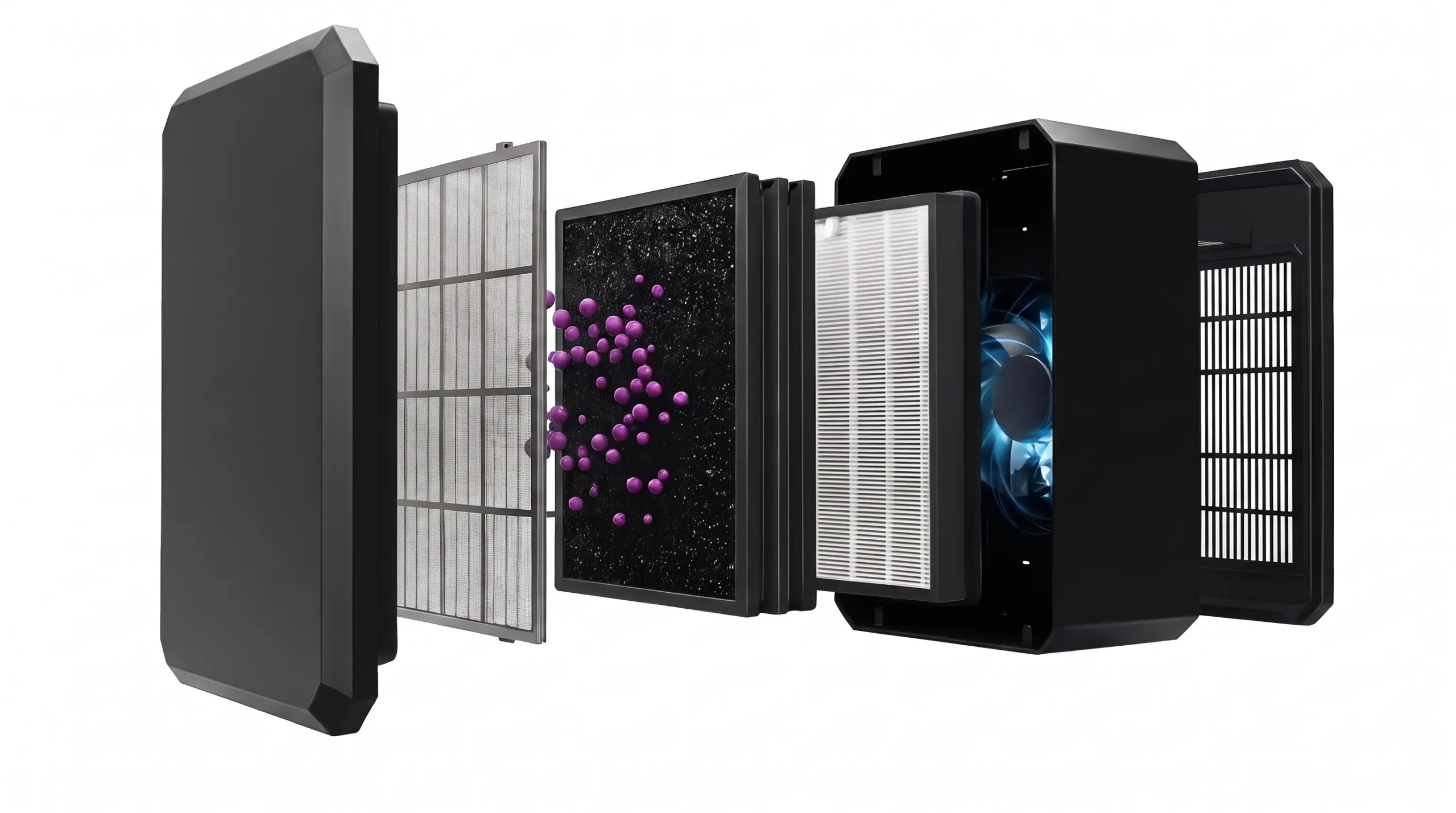
Molecular filtration operates on the principle of adsorption, which traps gaseous molecules onto the internal surfaces of highly porous substrates.
- Engineered Adsorbents: Activated carbon and activated alumina are the most commonly utilized materials for this process.
- Massive Surface Area: High-quality activated carbon features an expansive internal surface area, often exceeding 1,000 m²/g.
- The Trapping Process: Molecules diffuse into the adsorbent’s microscopic pores, repeatedly collide with the internal surfaces, lose their kinetic energy, and become permanently trapped.
- Targeted Eradication: While broad-spectrum carbon handles most volatile organic compounds (VOCs), the adsorbent can be chemically impregnated to target specific, highly reactive gases like ammonia and hydrogen sulphide.
The Four Dimensions of Molecular Contamination
Airborne molecules are generated by outdoor sources (vehicle exhaust, combustion, power generation) and indoor sources (processed wood, carpets, cleaning agents, plastics). These pollutants create severe complications across four primary categories:
- Odour Nuisance: Offensive smells originating from sources like wastewater treatment plants and rotting organic waste.
- Respiratory Irritation: City air often contains high levels of nitrogen dioxide, sulphur dioxide, and ozone, which inflame the respiratory tract and trigger conditions like asthma.
- Toxicity: Exposure to certain airborne chemicals, such as hydrogen cyanide, isocyanates, and dioxins, can cause severe reactions or fatalities even at low concentrations.
- Corrosive Damage: Acidic gases cause printed circuit boards (PCBs) to corrode and fail, threatening the uninterrupted operation of critical data centers and clean rooms manufacturing delicate semiconductor devices.
Real-World Architectural Deployments
1. Eliminating Hardware Failure in Critical Data Centers A multinational data center located near an intensive tannery industry suffered roughly 200 printed circuit board failures annually due to heavy hydrogen sulphide infiltration. To achieve the highest air purity category (G1 classification under ISA-71.04.2013), a multi-stage filtration system utilizing advanced molecular filters was deployed to pressurize the critical environments with clean air. The concentration of corrosive gases was successfully neutralized to G1 conditions, and PCB failure rates were reduced to zero.
2. Reconstructing Corporate Indoor Air Quality An engineering consultancy in India struggled with hazardous indoor levels of PM2.5 and formaldehyde. A 12,500 CFM recirculating air purification unit was installed, integrating ISO 16890 classified particulate filters, activated carbon molecular filtration, and final-stage HEPA filters. Following the deployment, indoor PM2.5 levels dropped drastically from 141 µg/m³ to just 7 µg/m³, while formaldehyde concentrations fell from 61.3 µg/m³ to 14.1 µg/m³.
3. Commercial Asset Protection in Entertainment Venues A multiplex cinema situated near a large wastewater drainage system experienced frequent projector failures mid-movie due to hydrogen sulphide corrosion on internal circuit boards. Initial environmental testing revealed harsh “G3” conditions. Because ventilation space was highly restricted, free-standing room air purifiers equipped with specialized molecular filtration were deployed directly inside the projection rooms and data center. The intervention successfully restored the environment to safe G1 conditions, bringing hardware corrosion to an all-time low.
Conclusion
As the data clearly demonstrates, physical particle nets are completely blind to molecular contamination. True environmental control requires dedicated molecular filtration utilizing active adsorption architectures to permanently remove gaseous threats from our breathing zones and critical infrastructure.